Launch offer — valid today only

📄 Digital book in PDF · read it on your phone or print it

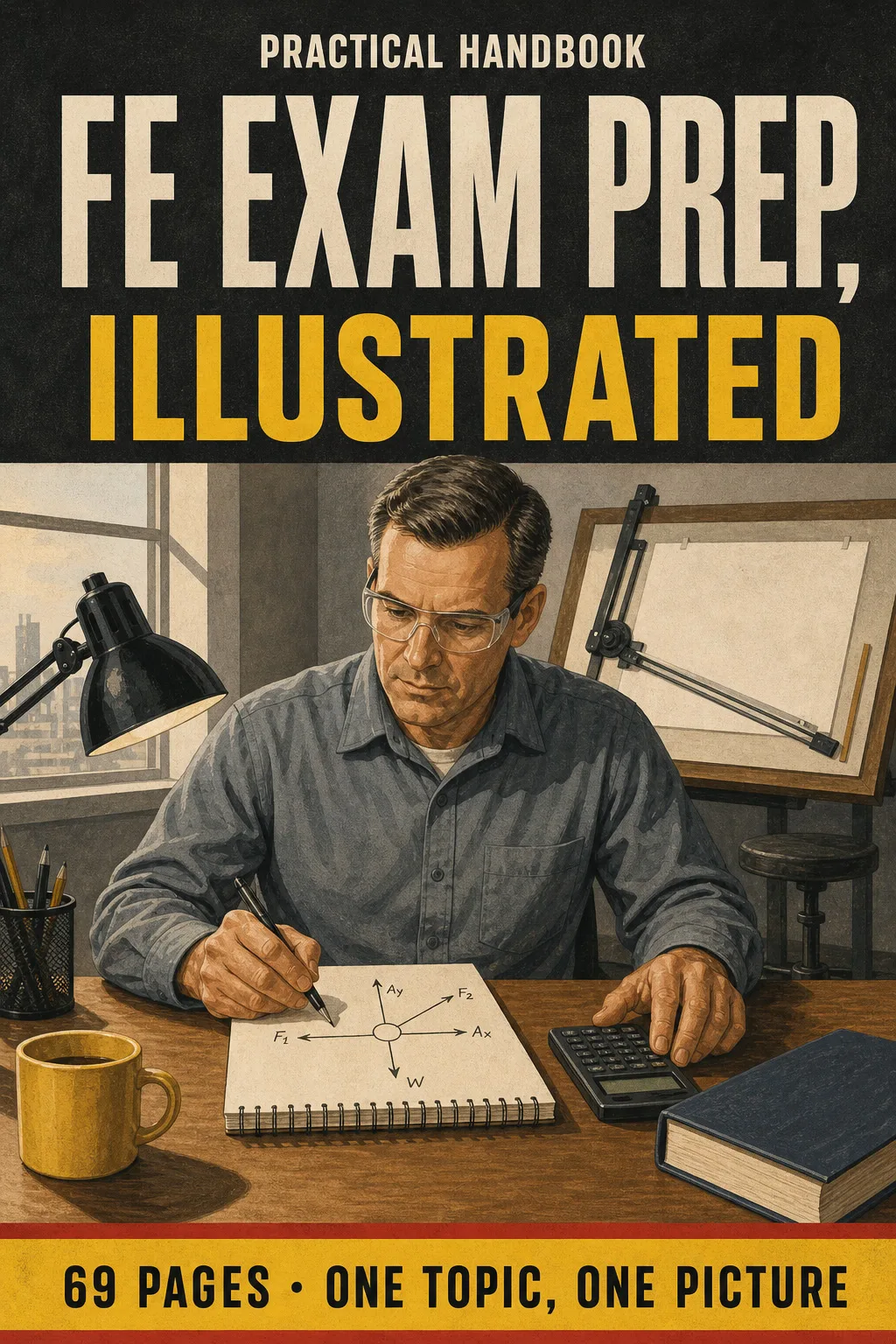
The FE Exam Core Subjects in Drawings Same 4 Steps on Every Page

For FE Civil, Mechanical and Other Disciplines: unit conversions, statics, trusses, Mohr's circle, beams, fluids, thermodynamics, circuits and engineering economics. One topic per page: the drawing first, then what you need to remember. 69 illustrated pages.

START STUDYING THIS WAY

🔒 Secure checkout · PDF by email · 30-day guarantee

Every topic, its own page4 steps on every topic: draw it, write the units, find the equation in the handbook, check the answer
69 illustrated pages9 parts, from how the FE exam works to the exam-day checklist
Up-to-date sourcesCurrent NCEES FE exam specifications and the FE Reference Handbook
PDF by emailFormat

Look Inside the Book

Every page has one big drawing and a box with the equations, units and steps you need to know:

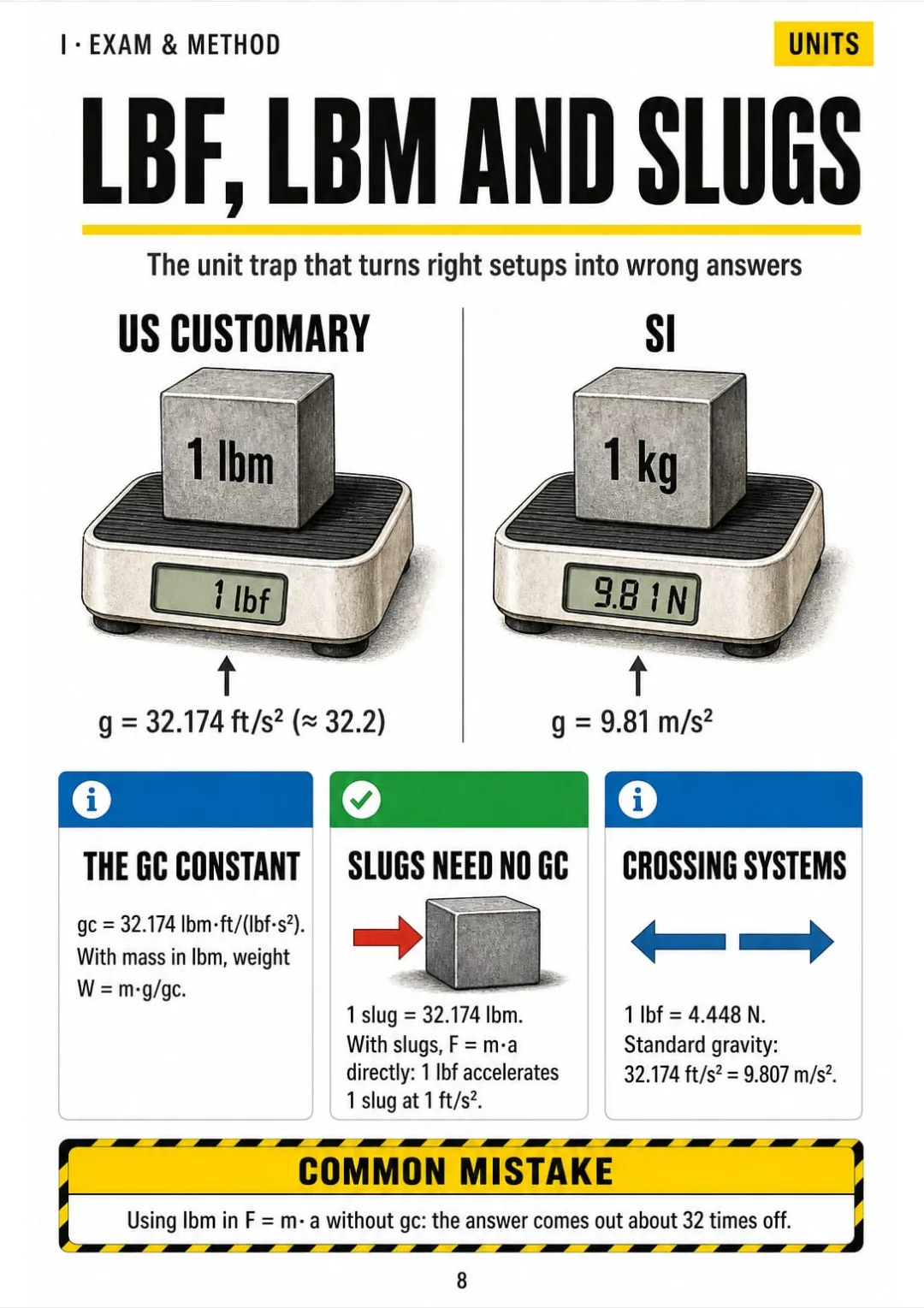
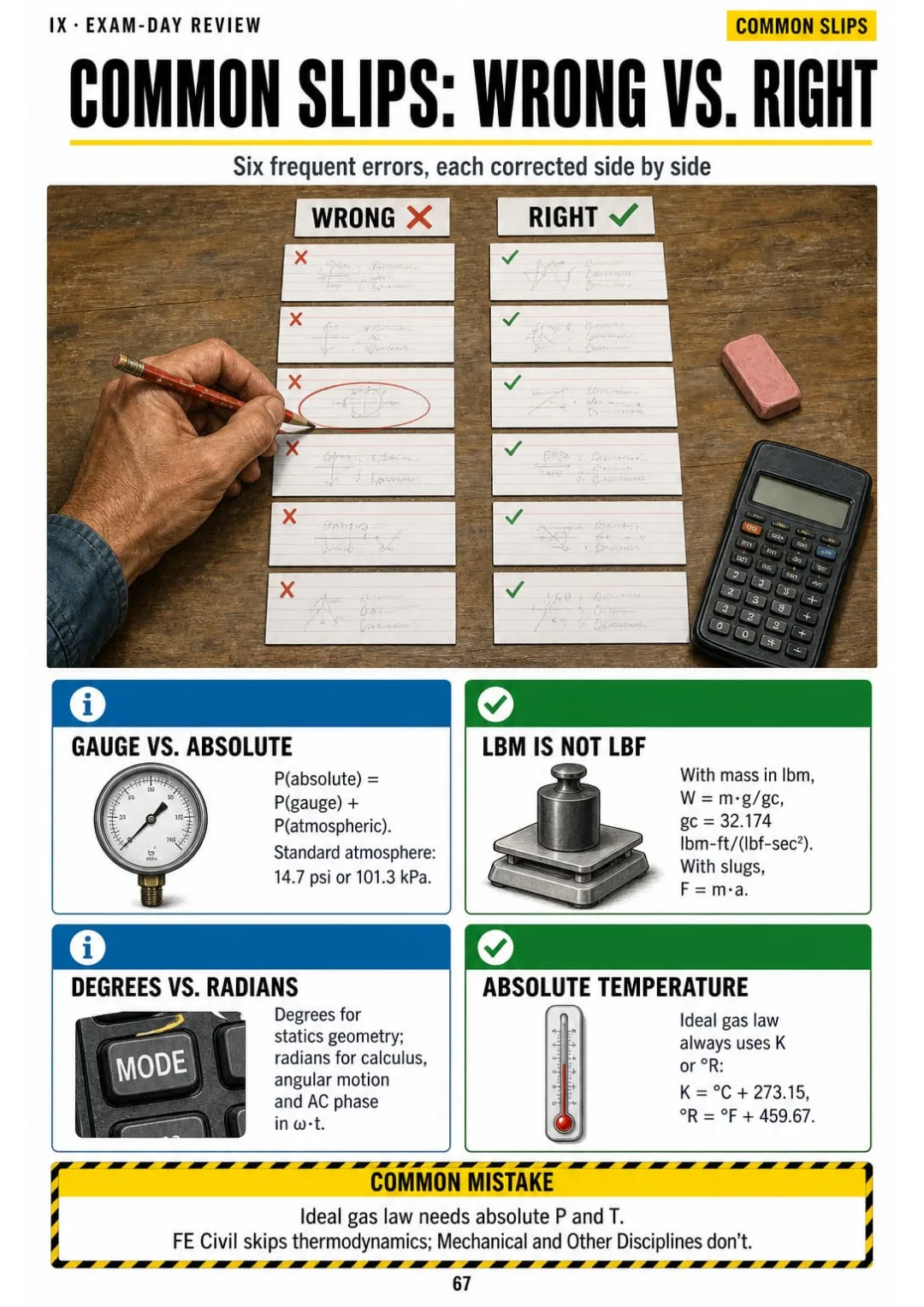
gc = 32.174 lbm·ft/(lbf·s²) · 1 slug = 32.174 lbm · 1 lbf = 4.448 N
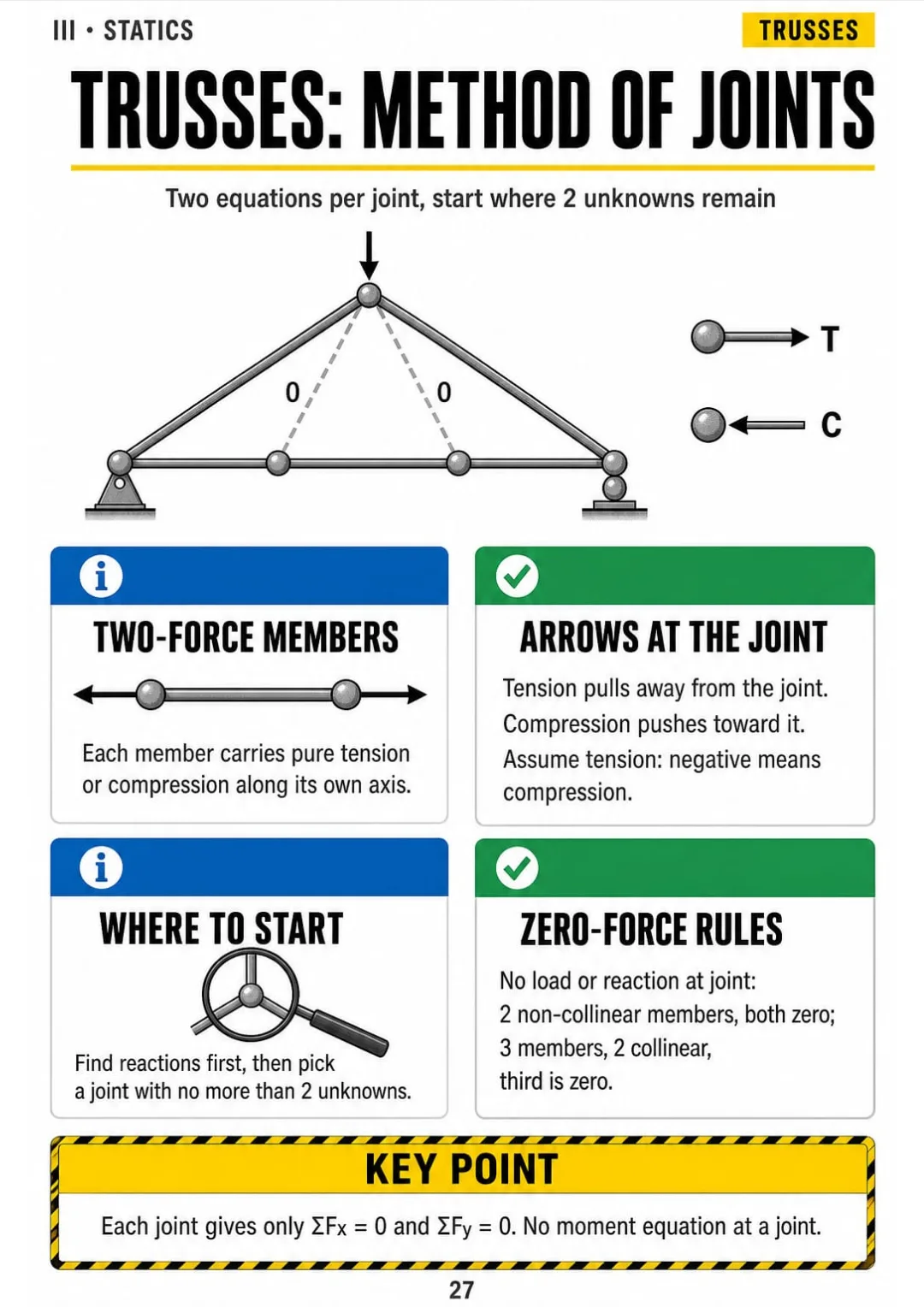
Two equations per joint, start with ≤ 2 unknowns, spot zero-force members first
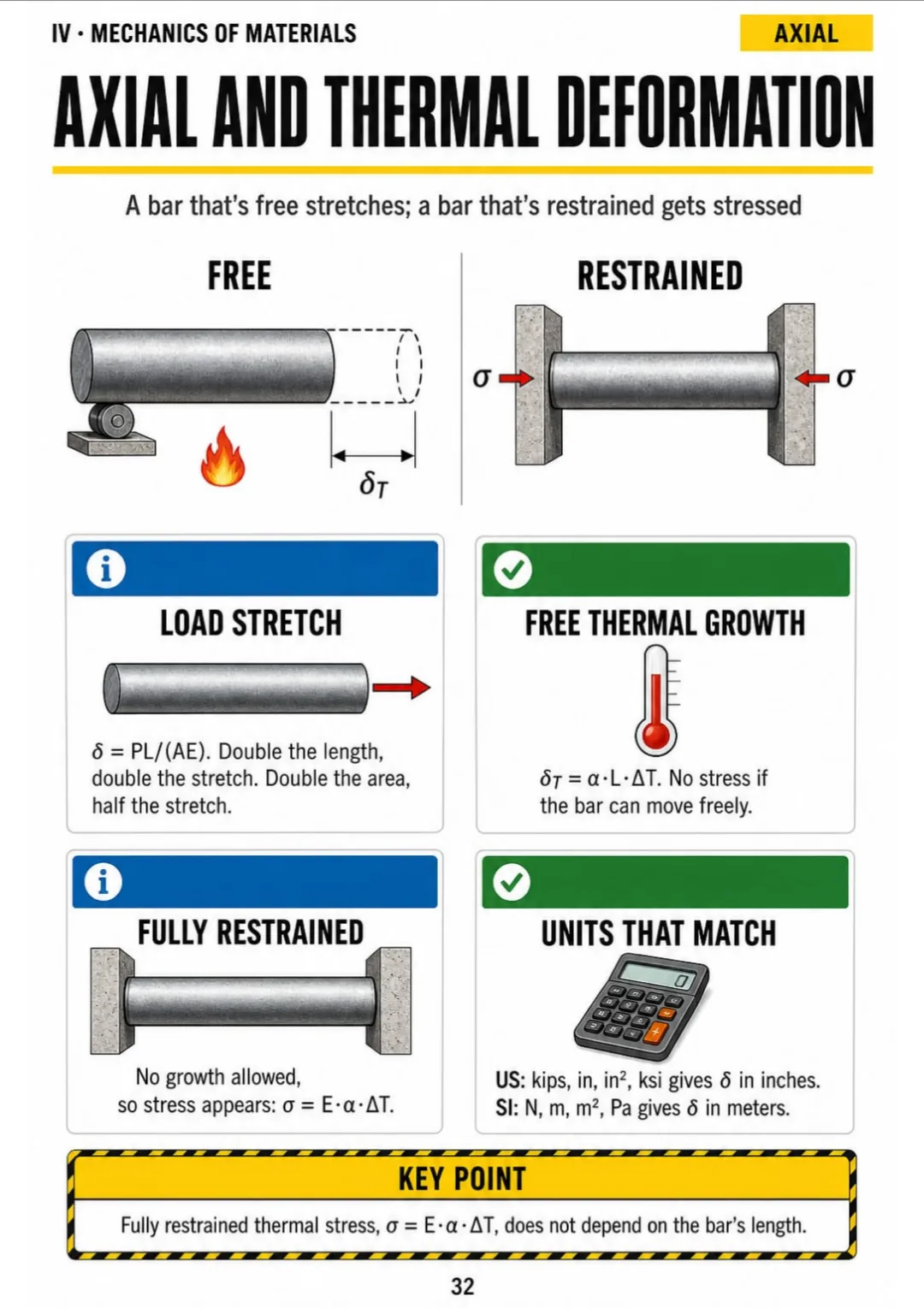
δ = PL/(AE), δT = α·L·ΔT, and σ = E·α·ΔT when the bar can't expand
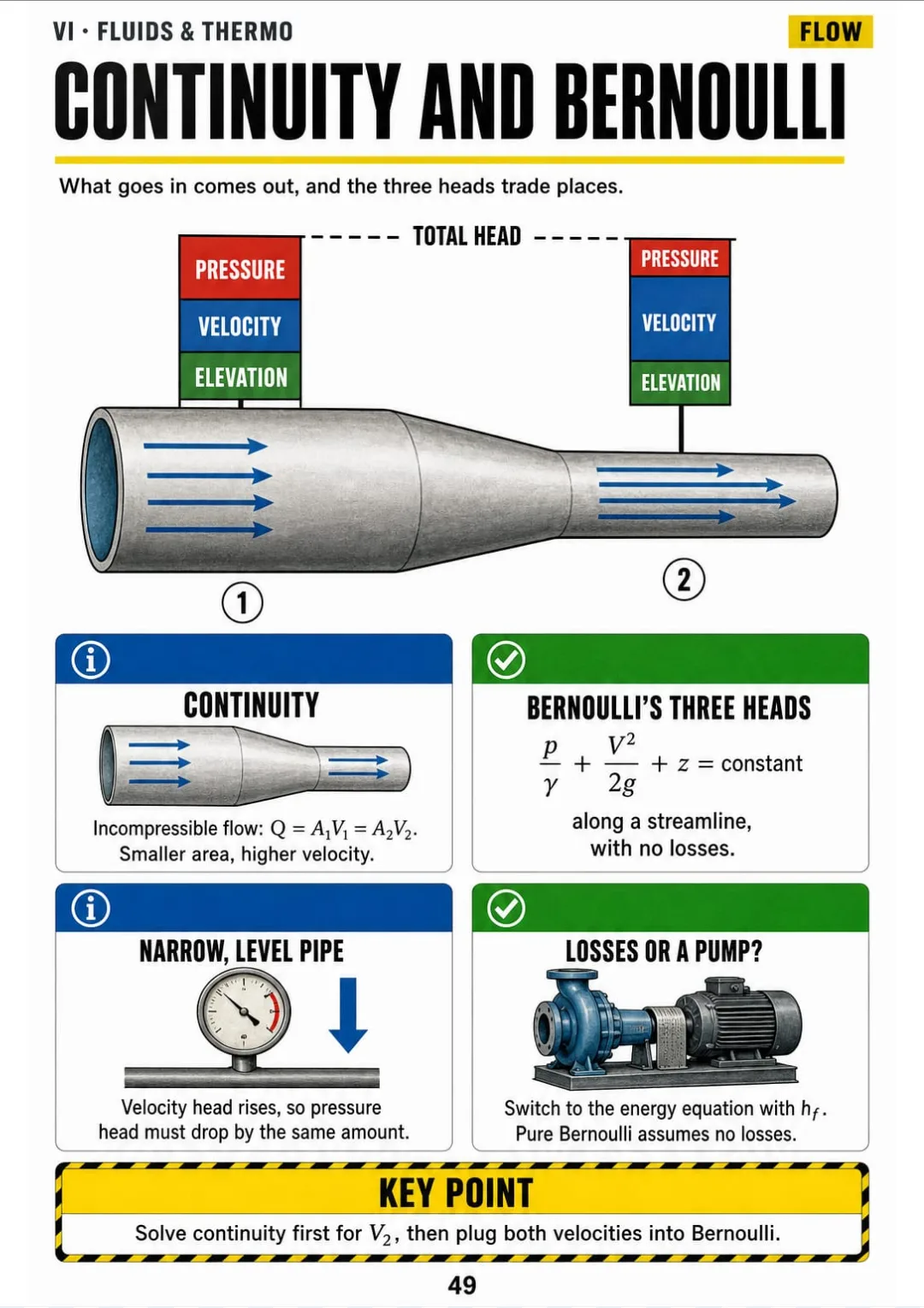
Q = A₁V₁ = A₂V₂ and p/γ + V²/2g + z = constant, drawn as head bars.
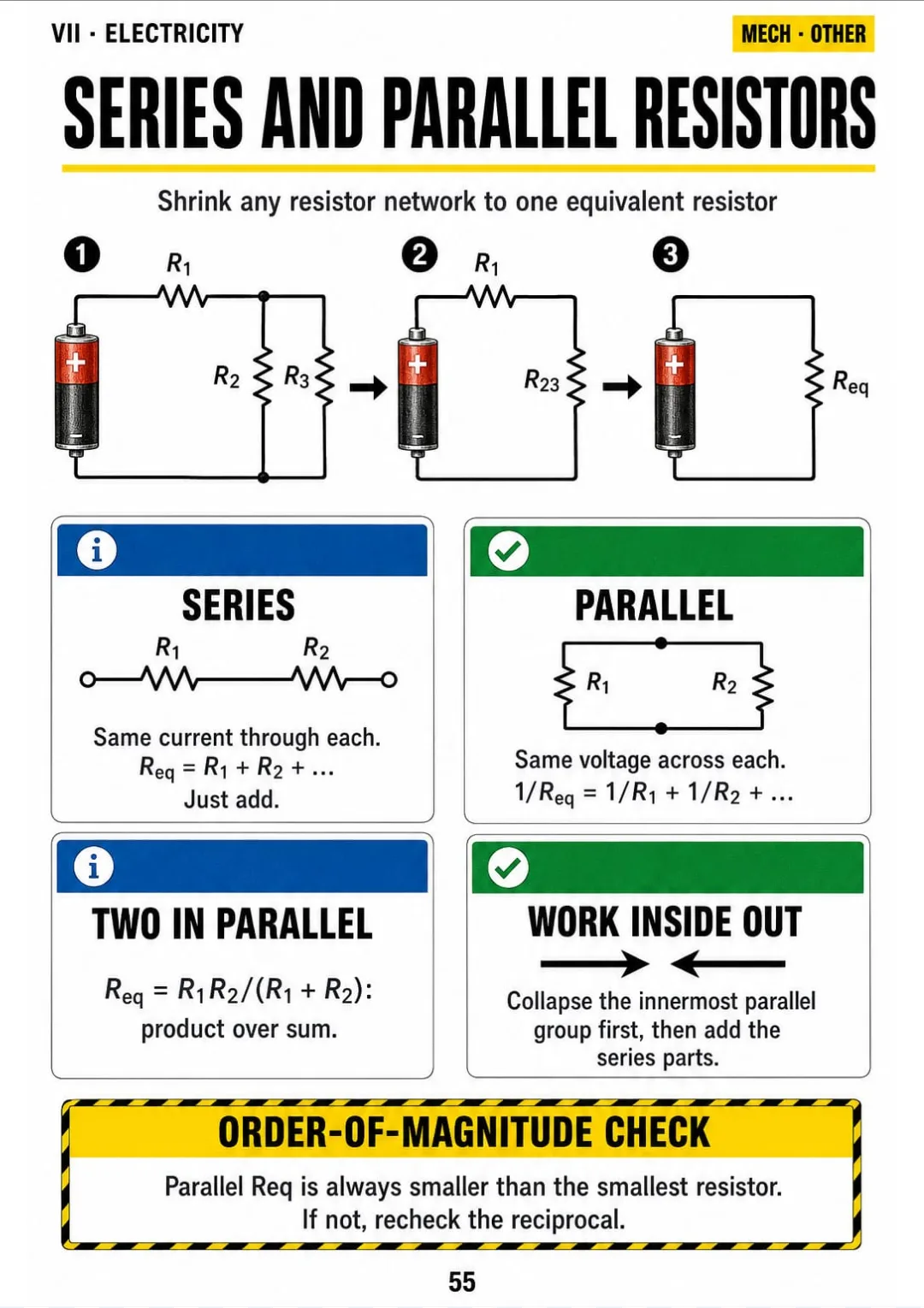
Series adds; parallel uses 1/Req = Σ1/Ri; two in parallel = product over sum
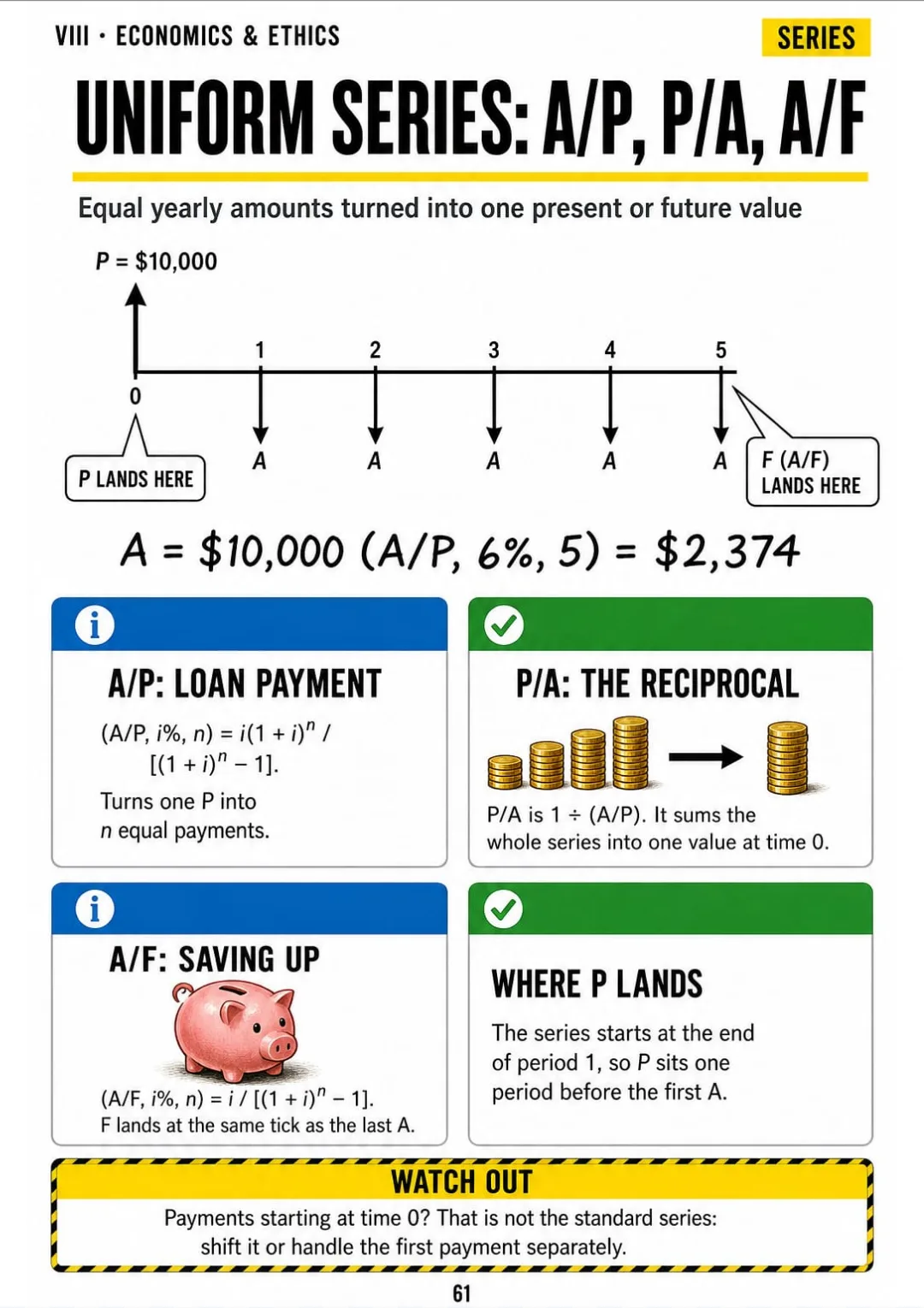
A $10,000 loan at 6% for 5 years: A = $10,000 (A/P, 6%, 5) = $2,374 per year.
Gauge vs. absolute, lbm vs. lbf, degrees vs. radians, n vs. n − 1: wrong and right side by side.
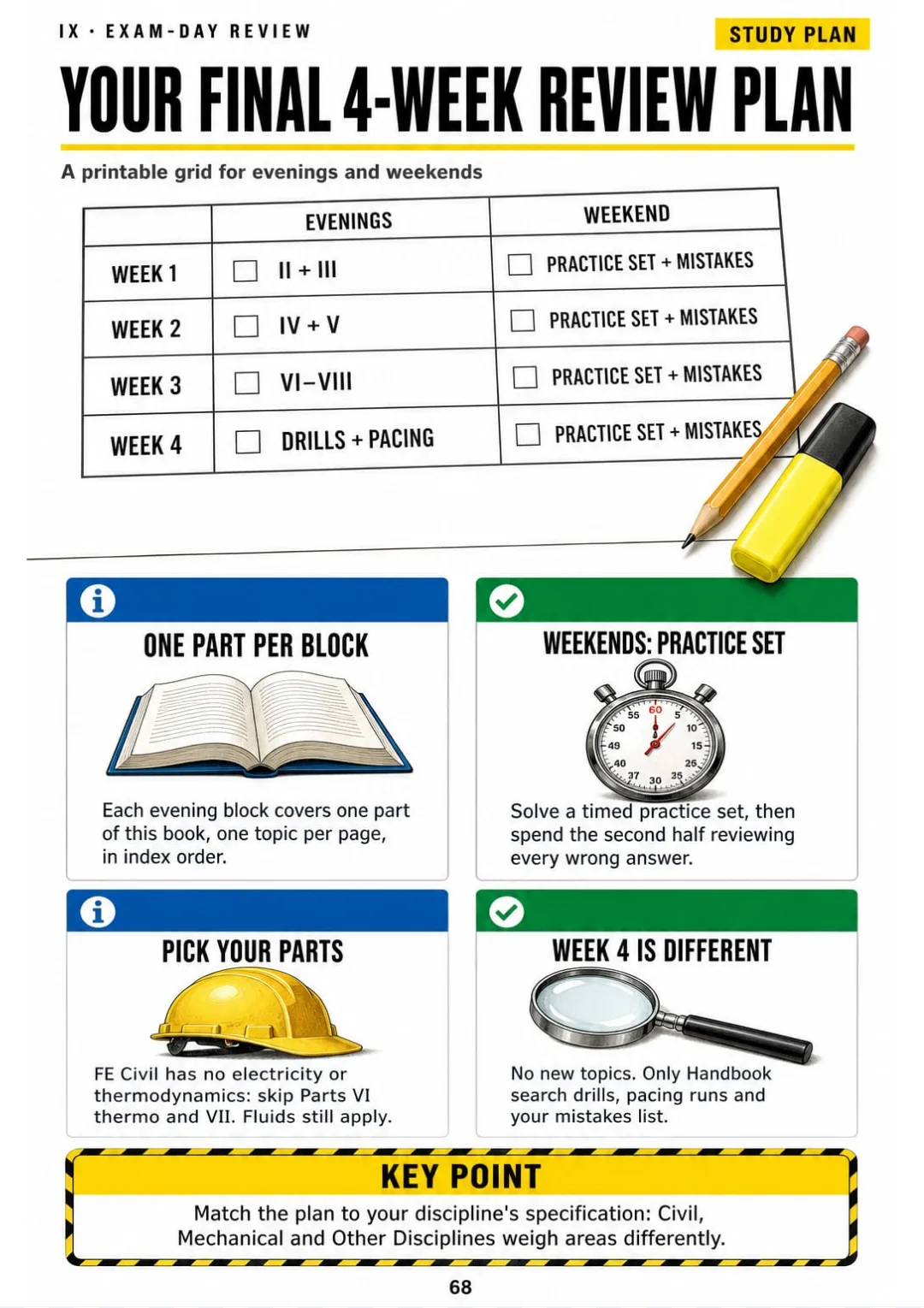
A week-by-week grid: one part per evening, practice sets on weekends, drills only in week 4.

Swipe to see more →

These are real pages from the book. The table of contents is the full one: 9 parts and 65 topics.

The Problem Isn't You. It's How It Was Explained to You.

You're on a practice problem: σx, σy and τxy on a stress element, and it wants the principal stresses and the angle. You know Mohr's circle is the way in. You just can't remember how to start it.

The review manual covers it in two pages of paragraphs and a long derivation. The steps are in there, buried between equations, and the 2θ detail sits in a sentence you skimmed late at night.

δ = PL/(AE), δT = α·L·ΔT, and σ = E·α·ΔT when the bar can't expand

In the book, Mohr's circle is one page: the circle drawn on σ–τ axes, the center at (σx + σy)/2, the radius R marked, σ₁ and σ₂ where the circle crosses the axis. Four numbered steps, with the 2θ angle drawn right on the circle.

Same with the method of joints, shear and moment diagrams, gauge vs. absolute pressure, Kirchhoff's laws and the cash flow diagram: each one has its own page.

You see the circle, you draw it, and you solve it without going back to the manual. And you know which section of the handbook to open.

COMPARE FOR YOURSELF

The Same Topic, Two Ways to Study It

THIS
  • The review manual: line after line of text
  • Trusses explained only in words
  • You read it twice and still don't know which joint to start at
The method of joints is predicated on the condition that, if a truss is in equilibrium, each of its joints must likewise be in equilibrium. Since the members of an ideal truss are two-force members, the forces acting at any joint constitute a concurrent coplanar system, for which only two independent equilibrium equations, ΣFx = 0 and ΣFy = 0, are available. Consequently, the analysis should commence at a joint possessing no more than two unknown member forces, with zero-force members identified beforehand by inspection.
FOR THIS
  • The method of joints in one drawing
  • The equations and the order of steps in a box
  • Start at a joint with 2 unknowns or fewer, circled on the drawing
Two equations per joint, start with ≤ 2 unknowns, spot zero-force members first
CONTENTS

Take a Look at the 9 Parts and 65 Topics

The exam and the method, mathematics and statistics, statics, mechanics of materials, dynamics, fluids and thermodynamics, electricity and circuits, engineering economics and ethics, and exam-day review: 69 pages, all illustrated

IThe Exam and the Method · pp. 5-10
  1. How the FE Exam Works
  2. The 4-Step Method You'll Use on Every Page
  3. Finding Equations in the Reference Handbook
  4. US Customary vs. SI: lbf, lbm and slugs
  5. The Order-of-Magnitude Check
  6. Your Calculator, Set Up for the Exam
IIMathematics and Statistics · pp. 11-20
  1. Quadratics and Logarithms in One Look
  2. Right Triangles and the Unit Circle
  3. Analytic Geometry: Lines, Circles, Areas
  4. Derivatives: Slope and Max/Min
  5. Integrals: The Area Under the Curve
  6. First-Order Differential Equations
  7. Vectors: Dot and Cross Product
  8. Matrices and Determinants
  9. Statistics: Mean, Standard Deviation, Normal Curve
  10. Probability: Combinations and Permutations
IIIStatics · pp. 21-30
  1. Resolving a Force into Components
  2. The Free-Body Diagram, Step by Step
  3. Supports and Their Reactions
  4. Moments and the Sign Convention
  5. The 3 Equations of Equilibrium
  6. Distributed Loads into a Single Force
  7. Trusses: Method of Joints
  8. Trusses: Method of Sections
  9. Centroids and the Parallel Axis Theorem
  10. Friction and Impending Motion
IVMechanics of Materials · pp. 31-39
  1. Stress, Strain and Hooke's Law
  2. Axial Deformation and Thermal Strain
  3. Shear and Moment Diagrams
  4. Bending Stress: σ = Mc/I
  5. Shear Stress in Beams
  6. Torsion in Shafts
  7. Beam Deflection from the Handbook Tables
  8. Column Buckling
  9. Mohr's Circle in 4 Steps
VDynamics · pp. 40-45
  1. Constant-Acceleration Kinematics
  2. Projectile Motion
  3. Newton's Second Law with an FBD
  4. Work and Energy
  5. Impulse and Momentum
  6. Rotation: Angular Motion and Moment of Inertia
VIFluids and Thermodynamics · pp. 46-53
  1. Gauge vs. Absolute Pressure
  2. Hydrostatic Pressure and Manometers
  3. Forces on Submerged Surfaces and Buoyancy
  4. Continuity and Bernoulli
  5. Reynolds Number and Head Loss
  6. The First Law and Ideal Gases
  7. Reading Steam Tables
  8. Power Cycles and Efficiency
VIIElectricity and Circuits · pp. 54-58
  1. Ohm's Law and Power
  2. Series and Parallel Resistors
  3. Kirchhoff's Laws
  4. Capacitors, Inductors and Time Constants
  5. AC Basics: RMS, Phasors, Power Factor
VIIIEngineering Economics and Ethics · pp. 59-64
  1. Drawing the Cash Flow Diagram
  2. Single-Payment Factors: P/F and F/P
  3. Uniform Series: A/P, P/A, A/F
  4. Comparing Alternatives: Present Worth and Annual Worth
  5. Depreciation and Break-Even
  6. Ethics and Licensure
IXExam-Day Review · pp. 65-69
  1. Pacing: About 3 Minutes per Question
  2. Handbook Search Drills
  3. The Most Common Slips, Wrong vs. Right
  4. Your Final 4-Week Review Plan
  5. The Night-Before and Exam-Day Checklist

One Page, One Topic, All Clear

Think of it this way:

It's a timed practice exam, two weeks before your date. A beam question comes up with a distributed load, and you have about three minutes for it. You need the free-body diagram first, and you need it fast.

The night before, you went over the free-body diagram page: the beam, each support with its reactions, the distributed load turned into one force at its centroid. Then the 4 steps: draw it, write the units, find the equation in the handbook, check it.

Series adds; parallel uses 1/Req = Σ1/Ri; two in parallel = product over sum

Same with trusses, Mohr's circle, submerged gates, series and parallel resistors and uniform-series factors: each one on its own page.

FE Exam Prep, Illustrated is 9 parts and 65 topics, all drawn, with handbook search drills, the most common slips and a 4-week review plan at the end.

What you see drawn, you don't have to memorize.

What's Inside FE Exam Prep, Illustrated:

Ipp. 5-10

The Exam and the Method

How the FE exam works, the 4-step method, finding equations in the handbook, lbf, lbm and slugs, the order-of-magnitude check and your calculator setup.

IIpp. 11-20

Mathematics and Statistics

Quadratics and logs, right triangles, analytic geometry, derivatives, integrals, first-order differential equations, vectors, matrices, statistics and probability.

IIIpp. 21-30

Statics

Force components, the free-body diagram, supports and reactions, moments and signs, the 3 equilibrium equations, distributed loads, trusses, centroids and friction.

IVpp. 31-39

Mechanics of Materials

Stress and strain, axial and thermal deformation, shear and moment diagrams, bending and shear stress, torsion, deflection, buckling and Mohr's circle.

Vpp. 40-45

Dynamics

Constant-acceleration kinematics, projectiles, Newton's second law with an FBD, work and energy, impulse and momentum, and rotation.

VIpp. 46-53

Fluids and Thermodynamics

Gauge vs. absolute pressure, manometers, submerged surfaces and buoyancy, continuity and Bernoulli, Reynolds number, the first law, steam tables and power cycles.

VIIpp. 54-58

Electricity and Circuits

Ohm's law and power, series and parallel resistors, Kirchhoff's laws, capacitors and inductors, and AC basics: RMS, phasors and power factor.

VIIIpp. 59-64

Engineering Economics and Ethics

The cash flow diagram, single-payment and uniform-series factors, present worth and annual worth, depreciation, break-even, ethics and licensure.

IXpp. 65-69

Exam-Day Review

Pacing per question, handbook search drills, the most common slips wrong vs. right, a 4-week review plan and the exam-day checklist.

At the end of the book: Handbook search drills, the most common slips wrong vs. right, a 4-week review plan and an exam-day checklist.
Plus: 2 Free Books

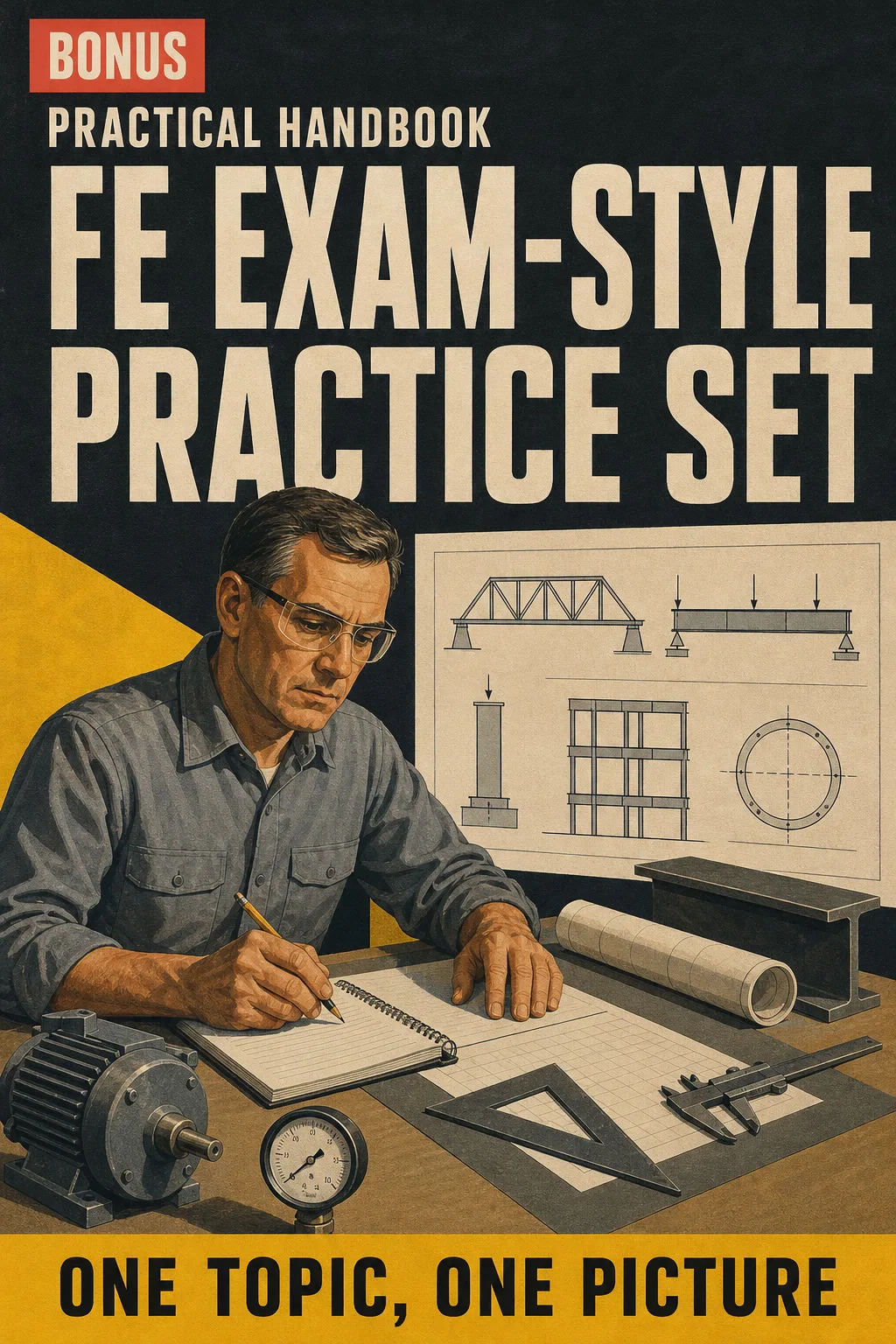
FE Exam-Style Practice Set

BONUS 1: «FE Exam-Style Practice Set»

Value on its own: US$ 17.90

Exam-style questions across every core subject, each with a step-by-step drawn solution, so you practice the same 4 steps until they're automatic.

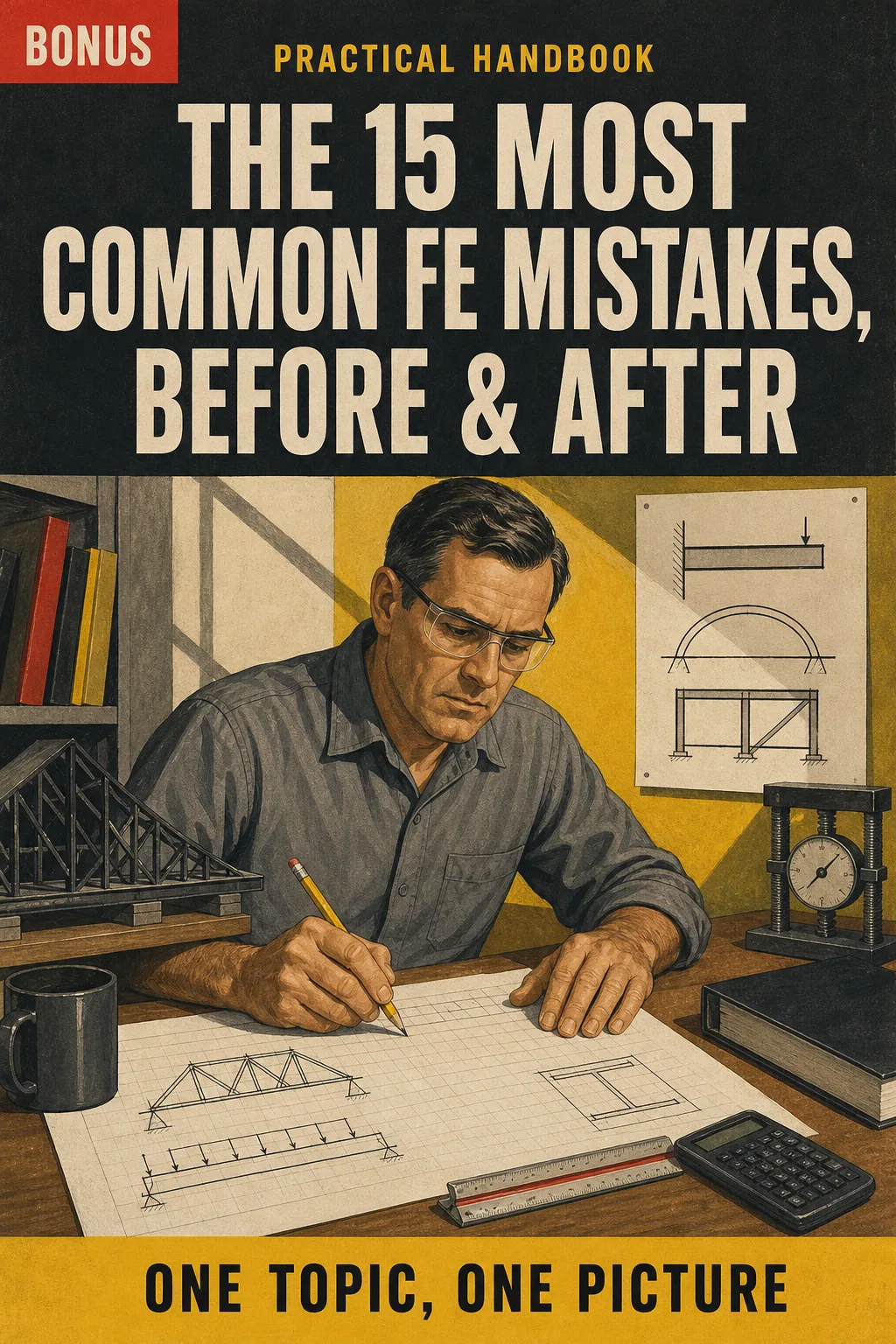
The 15 Most Common FE Mistakes, Before & After

BONUS 2: «The 15 Most Common FE Mistakes, Before & After»

Value on its own: US$ 14.90

The slips that cost points—wrong sign on a moment, gauge vs. absolute pressure, mixed units—shown wrong and right side by side, for a quick review before exam day.

FE Exam Prep, Illustrated with 2 Free Books

  • FE Exam Prep, Illustrated: 69 illustrated pagesUS$ 63
  • BONUS 1: FE Exam-Style Practice SetUS$ 17.90
  • BONUS 2: The 15 Most Common FE Mistakes, Before & AfterUS$ 14.90
  • High-resolution PDF to printIncluded
Total value US$ 95.80
YOUR PRICE:
US$ 27
You save US$ 68.80
YES, I WANT FE EXAM PREP, ILLUSTRATED FOR US$ 27

📄 This is a digital PDF book sent to your email: nothing is printed or shipped.

Secure purchaseEncrypted payment30-day guarantee

PDF by email: We email you FE Exam Prep, Illustrated as a PDF, together with the two free books. It's a single payment: no installments, no extra charges.

Who This Book Is For

You're starting your FE review

You're starting your FE review

Every core subject laid out one page at a time, so you can see the whole exam before you go deep on any part.

Your exam date is close

Your exam date is close

One page per topic to review at a glance, the most common slips side by side and a 4-week plan for the final stretch.

You already work in engineering

You already work in engineering

Statics, fluids and circuits drawn again, years after school, with the same 4 steps every time and no need to sit through the whole degree again.

Everything You Get Today

US$ 95.80US$ 27
YES, I WANT FE EXAM PREP, ILLUSTRATED FOR US$ 27

📄 This is a digital PDF book sent to your email: nothing is printed or shipped.

30DAYS
GUARANTEE

30-Day Guarantee

Try FE Exam Prep, Illustrated for 30 days, bonus books included.

We refund everything if the file won't open, if the book isn't what you see here, if you were charged twice or if the email doesn't arrive. Just email us.

You pay once. No subscriptions.

Frequently Asked Questions

Is it for me if I've worked in engineering for years and never took the FE?

Yes. Every core subject is redrawn from the basics, one page at a time, with worked examples in US customary and SI units. It's built around the subjects shared by the FE Civil, FE Mechanical and FE Other Disciplines exams. It doesn't cover discipline-only topics such as structural design, HVAC or power systems, so keep your discipline review for those.

Where does the content come from?

It's checked against the FE exam specifications for Civil, Mechanical and Other Disciplines and the FE Reference Handbook currently published by NCEES, and against standard engineering textbooks. Each page points you to the handbook section where the equation lives. We teach you how to use the handbook; we don't copy its pages.

Is this official material?

No. It's independent study material. It is not affiliated with or endorsed by NCEES or any state licensing board.

Does it replace a review course or my degree?

No. It's a visual review, not a full course. Each page goes from the core idea to an exam-style worked example, always in the same 4 steps, so it isn't just the basics. Use it next to your course, your practice problems and the handbook to see each topic at a glance and solve it in the same order.

Are the practice questions the ones on the exam?

No. They're exam-style questions written for this book, not official questions from any exam.

When and how do I get it?

The book and the 2 bonus books arrive as PDFs by email, at the address you enter at checkout.

Do I have to pay every month?

No. It's a one-time payment. No subscription.

Can I print it?

Yes. The PDF is made to print, so you can keep the pages next to the handbook while you practice.

How does the refund work?

You have 30 days. We refund everything if the file won't open, if the book isn't what you see on this page, if you were charged twice or if the email doesn't arrive: just email us.

Before You Close This Page

No more rereading without anything sticking.

Mohr's circle, trusses and free-body diagrams: you see them drawn, and that's it.

You walk into the FE exam knowing where everything is.

Drawings make studying faster.

The book is right below.

One-time payment: US$ 27 · Guarantee: 30 days · PDF by email

YES, I WANT FE EXAM PREP, ILLUSTRATED FOR US$ 27

📄 This is a digital PDF book sent to your email: nothing is printed or shipped.